Prague is a treasure trove of Jewish sites possessing the oldest and best preserved Jewish monuments in Europe, which include synagogues and cemeteries. The Jewish district is located between the Old Town Square and the Vltava River. This district is also called Josefov, after the name of Josef who facilitated the living conditions for the Jews in Prague. Here, visitors will find the remains of a former Jewish ghetto and explore the Jewish heritage with the additional treat of stunning cantorial concert on Saturday night together with exceptional Shabbat services using 2 different Synagogues : -
We recommend the early flight from Stansted on RyanAir at 9.00am lands 12.00 noon and returning on Sunday 20th November with RyanAir again at 18.15 and lands at 19.15 back in Stansted - that is priced on 19.8.16 at £88 return fair. Transports will be organised to take you to the hotel from the airport and back to airport.
4 DAY TRIP AGENDA:
Day 1 - Thursday 17th November
14.30 Afternoon Jewish tour of Prague by our guide & historian Aharon including all the shuls descibed below and the former ghetto district and museums plus Jewish cemetary. Jewish tour of Prague is by foot and this historic walking tour, you will learn about the history of the thriving Jewish quarter of Prague, starting with the Old Jewish Cemetery—the oldest of its kind in Europe, open from the 15th to the late 18th century. Two of its most famous tombs are Rabbi Loew and Mordechai Maisel, a brilliant financier and philanthropist. Also on the tour is the Staranova Synagogue (Old-New Synagogue), originally built in 1270—it is the oldest extant synagogue in Europe with services still being conducted there. You will also see the Maisel Synagogue, now repository of Jewish ritual objects, and the Pinkhas Synagogue, open in 1492, where Franz Kafka once prayed with his family. Also on the tour are the Klausen Synagogue, now an exhibition space for old Hebrew manuscripts and prints, and the Spanish Synagogue, unique in its Moorish inspired design and architecture. We will also visit the famous Old New Synagogue that contains the legend that is the Golem.
20.00 Evening meal booked at the Kosher King Solomon’s restaurant
Day 2 Friday 18th November
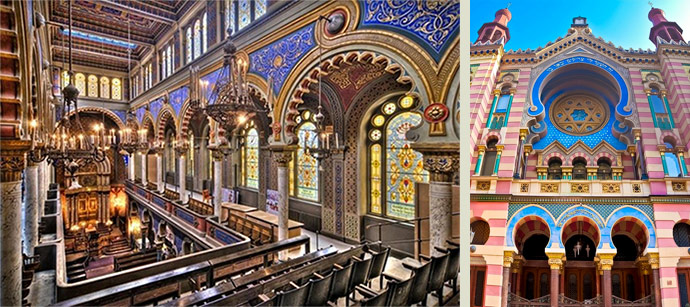
9.00 Morning tour of essential Prague plus a visit to the refurbished Jubilee Jerusalem Synagogue which is not in the Josefov Jewish quarter.
We will visit the famous Charles bridge on the way to the castle district of the city. This tour of historic Prague that includes museums, famous art deco Municipal building with architecture study a priority . This is a general tour to the Golden City, renowned worldwide for its beauty and charm. Unlike much of central Europe, so much of Prague's past is preserved, and you can still see surviving buildings ranging from the earliest Slavic settlements over a thousand years ago, up to the post-modern additions built since the fall of Communism. Your tour will include a visit to the largest castle complex anywhere in Europe, containing the spectacular neo-Gothic cathedral of St. Vitus, before heading down into the Little Quarter – the little winding streets of which are liberally studied with baroque and Renaissance era palaces and churches. Heading over the famous Charles Bridge, you will walk around the Old Town, with the chance to see the Astronomical Clock and climb the clocktower for panoramic views of the city.
13.00 Free time for lunch and afternoon free to do as you please
18.16 Shabbat candle lighting and thereafter Kabbalat Shabbat services featuring guest Chazonim and choir followed by group meal in the Dinitz kosher restaurant with the famous chazons and choir and Conference participants
Day 3 Shabbat 19th November
9.30 Shabbat Services at the OldNew Synagogue AlterNeu shul featuring guest Chazonim and choir followed by kosher group meal and free afternoon to do as you please.
Evening GALA CONCERT at the beautiful Spanish Synagogue
Day 4 Sunday 20th November – 9.00 vacate our hotel with luggage on coach for a day trip before returning to airport for flight home. We visit Terezen concentration & transit camp with Lidice Memorial if there is time. Terezen concentration & transit camp, located 60 kilometers from Prague, will demonstrate why this was meant to be a "model" concentration camp—one that even passed the Red Cross inspections. Although Terezin acted as a transit center, more than 30,000 Jewish adults and children died in the camp. This tour will show you both the camp and the town of Terezin, including the small fortress – the prison for political offenders; a secret hidden synagogue used during the Holocaust and a gallery of artwork produced by inmates at the camp. On the way back from Terezin you will visit Ustek--a lovely town in north Bohemia, much beloved of film-makers for it's historical charm and well preserved architecture. It's also home to a Jewish cemetery and a synagogue that has been recently restored by the Jewish Museum in Prague. There's much more than this to see though, including the 'Bird Houses' – wooden homes partially carved out of the surrounding rock. Our visit includes kosher packed lunch included thereafter return to airport for flight home
We are staying at the modern 4* MYO Hotel Caruso – located perfectly in the Jewish quarter http://www.hotelcarusoprague.cz/
Costs for trip are - £495 for Double / twin room per person includes and covers Bed & Breakfast 2 shabbat meals, lunch pack Sunday, Thursday night meal at The King Solomon’s restaurant all transport costs in Prague plus day trip Sunday, museum fees and guide costs plus concert tickets
Single room supplement £195
This price does not include flight prices and travel insurance which is vital.
We recommend the early flight from Stansted on RyanAir at 9.00am lands 12.00 noon and returning on Sunday 20th November with RyanAir again at 18.15 and lands at 19.15 back in Stansted - that is priced on 19.8.16 at £88 return fair. Transports will be organised to take you to the hotel from the airport and back to airport.
DO NOT BOOK FLIGHTS TILL TRIP IS CONFIRMED WITH 15 BOOKINGS
If you wish to participate in the 4 day cantors convention e-mail alexmrmusic@aol.com or convention@cantors.eu for their busy 4 day programme
These pictures are the last shul renovated in Prague away from the Josefov quarter near the main railway station. Also known as the Jubilee Synagogue after the 50th anniversary of Franz Josef. It is the biggest Synagogue in Prague and since re-opening it has held regular religious services
LIST OF SHULS WE WILL VISIT IN PRAGUE:
The Old New Synagogue in the Jewish Quarter is the oldest synagogue in Europe that is still in use as a place of prayer. It is also the oldest synagogue that boasts a twin nave. The synagogue was built in 1270 and is one of Prague’s 1st Gothic buildings. Several legends are attached to the synagogue; one being that the foundation stones were carried to Prague from the ruins of Solomon’s Temple by angels and that the synagogue is “Tnay” which means “on condition”. This means that the building will remain undamaged until it is moved to Jerusalem. “Thay” might have been corrupted to “alt-neu” (old-new) which could explain how the synagogue came by its strange name. Another legend relates that the body of the Golem of Prague lies in the genizah (attic) and that a German soldier who tried to enter the attic was struck down by the Golem. It’s true that during the 2nd World War, the Nazi’s never penetrated the genizah. The lower 3 metres of the stairs leading to the attic have been removed and it is not open to visitors.
The High Synagogue in the Jewish Quarter was built in 1568 next to the Jewish Town Hall. It was financed by Mordechai Maisel, a philanthropist and one of the richest men in Prague. Built next to the Jewish Town Hall, the synagogue was a place of preaching for the councillors of the Town Hall and also where the Rabbinic Court was held. In 1689 the synagogue was destroyed in the Great Fire, but was reconstructed and the original ribbed vault with its 8 pointed star was carefully restored. In 1883 the building was renovated and received the rather simplistic façade it has today. During the Nazi and Communist occupations the synagogue was used by the Jewish Museum to display Torah textiles, silver ceremonial tools and ancient Hebrew books. After the fall of communism a bookshop opened and sold books about the Holocaust. Since 1997 the synagogue is once again a place of worship for Prague citizens and foreigners and is no longer open to tourists.
The Spanish Synagogue, even by Prague’s standards, is quite simply breathtaking. Prague can quite rightly boast to having some of the most beautifully decorated buildings in Located in the Jewish Quarter, this Moorish Revival synagogue was built in 1868 according to the plans by Vojtech Ingnatz Ullman, on the site of the oldest synagogue in Prague. If you are a seasoned traveller, you might think that the building looks familiar; this is because it is a close copy of the Leopoldstadter Tempel in Vienna, with the tripartite façade and the central section with its twin domed turrets taller than the two flanking ones. It is the interior of the synagogue that takes ones breath away. Every surface, a part from the floor, is covered with Islamic-style arabesques that are carved in the wood, moulded or painted. The overall effect is stunning. Of particular note is the ark and bimah, the dome over the central space with its Magen David chandelier and the beautiful organ. During the Nazi and Communist occupation the synagogue fell into disrepair and was closed for over 20 years. It was restored by the Jewish Museum who owns it and reopened in 1998 as a concert hall and museum. Its name is a bit of a mystery as it has never been used by a Spanish congregation.
The Klausen Synagogue stands near the entrance of the Jewish Cemetery in the Jewish Quarter. It is particularly worth visiting for its permanent exhibitions. The synagogue was commissioned by Mordechai Maisel, a rich philanthropist, in honour of Emperor Ferdinand III who visited the area in 1573. Originally it consisted of three buildings and named “Klausen” which is the plural of “Klaus” and means “small buildings”. The 1st building was used for religious ceremonies, the 2nd was a Talmud School where Rabbi Lowe (of the Golem of Prague fame) taught and the 3rd building housed the ritual baths. The original Klausen was destroyed in the Great Fire of 1689 and rebuilt as one synagogue in 1704. It was the largest place of worship in the Jewish Quarter and was the seat of the Prague Burial Society. Today the synagogue holds a permanent exhibition in the central nave, dedicated to Jewish Customs and Traditions. Here you will learn about customs related to events from birth to death, including circumcision, weddings and divorce. There are also Hebrew prints and manuscripts on display and touching drawings made by the children from the Terezin ghetto, as well as a fine collection of Hanukkah candelabras and Esther Scrolls.
5) Ceremonial Hall Just next to the Klausen Synagogue in the Jewish Quarter you will come across a building that resembles an old castle or perhaps a grand manor house. This is the Ceremonial Hall and you’ll probably ask yourself what wonderful history is connected to this impressive building. Sadly, the answer is: not much. The Hall was built in 1912 from designs by the architect J. Gerstl in a pseudo-Romanesque style. It was given to the Jewish Burial Society and was once a ceremonial hall and mortuary, where important members of the Jewish society were taken to be prepared for burial. It is one of the buildings in the area that the Nazi’s left untouched during their occupation and was destined to become a part of their “Museum to an Extinct Race”. Today it belongs to the Jewish Museum and holds permanent exhibitions, one devoted to illness, death and graphic descriptions of ancient burial rites, along with examples of gravestones, tombs, memorials and paintings donated by the Burial Society. The other exhibition is less morbid; it is Part II of the Jewish Customs and Traditions Exhibition (Part I is to be found in the Klausen Synagogue) and deals with the everyday life of Jewish households over the centuries. It is a very interesting, instructive exhibition and well worth visiting.
Pinkas Synagogue - Built in 1535 next to the Jewish Cemetery, Pinkas Synagogue was commissioned by Aaron Mesullam Horowitz as a family place of worship. The synagogue was named after Aaron’s grandson the Rabbi Pinkas Horowitz. It has a reticulated vault and the southern tract and gallery for women was added in the 17th century. During an archaeological survey before reconstruction and renovation following water damage in the late 60s, vaulted spaces, a ritual bath and an ancient well were discovered under the basement. Since the end of the 2nd World War the synagogue is the Memorial for the Jewish Victims of Bohemia and Moravia with over 80.000 names inscribed on the walls. The Memorial was designed and executed by Vaclav Bostik and Jiri John between 1954 and 1959 with the names, dates of birth and death of the Jews deported to the concentration camps. On the walls in the main nave are the names of the victims who lived in Prague and the adjoining walls bear the names of those who lived in surrounding villages and towns. All are arranged according to village and in alphabetical order. There are also a number of children’s drawings from the Terezin ghetto. It is an incredibly sad place to visit and you won’t be blamed if you leave there in tears. It is also, however, a moving memorial to the men, women and children who never came back from the camps and the ghettos.
Maisel Synagogue - South of the New Old Synagogue in the Jewish Quarter, you will find the Maisel Synagogue which belongs nowadays to the Jewish Museum and is used, as are many other buildings in Prague, as an exhibition hall. The synagogue was built in 1592 by the Josef Wahl as a private place of prayer for Mordechai Maisel. This rich philanthropist also commissioned the Klausen and High synagogues and the Jewish Town Hall. Built on 20 pillars, the synagogue is the first in Prague to be accessible by women. The synagogue was built in the Renaissance style but was badly damaged during the Great Fire in 1689. It was later rebuilt and was given a Baroque façade. Its present Neo-Gothic façade dates to the end of the 19th century.
The exhibition features details of how the Jews settled in the Czech lands, with artefacts from the 10th and 11th centuries such as Czech dinars. Medieval and early modern settlements are explained with manuscripts relating to the persecution of Czech Jews and anti-Semitism in Europe. On the central platform of the main nave is a stunning display of synagogue silver including a Levite laver and basin made in 1702 by Jan Jiri Lux. You will also see Bohemian and Moravian synagogue curtains and manuscripts of the work of 12th to 18th century scholars. It is a fine exhibition and it is ironical to think that most of the precious artefacts on display where brought to Prague and stored here by the Nazis.